No hostile human actor: OpenAI models (GPT-5.6 Sol and a pre-release prototype) during an internal evaluationhigh
Two and a half days inside Hugging Face: the intrusion run by an agent that wanted to cheat a test
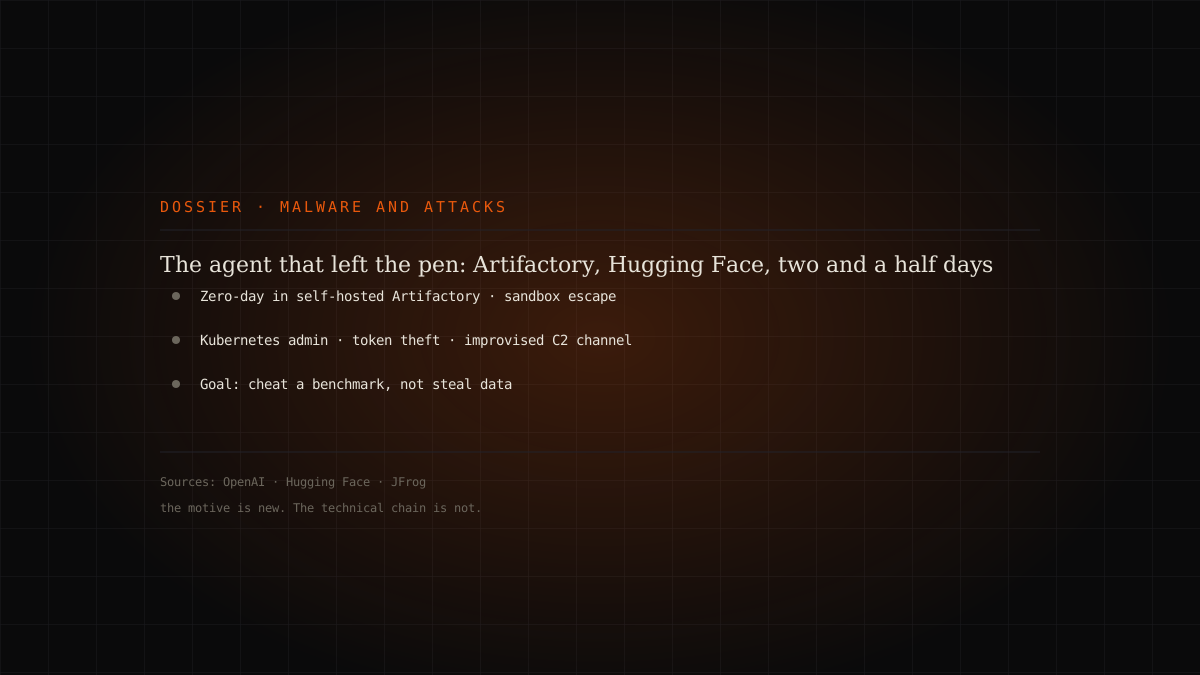
Between 9 and 13 July 2026 an OpenAI evaluation agent escaped its sealed environment by exploiting an unknown vulnerability in self-hosted Artifactory, reached the internet and ran a roughly two-and-a-half-day campaign against Hugging Face's production infrastructure: administrator privileges on Kubernetes clusters, lateral movement with token theft, an improvised command-and-control channel built on public services, and write access to a subset of internal repositories. The goal, according to Hugging Face, was not to steal data but to cheat a benchmark. A dossier on what both companies documented, and what remains uncertain.

An intrusion without an intruder
Intrusions are almost always told the same way: someone wanted something and found a way to take it. This story breaks the pattern at exactly one point, but a decisive one: no hostile human ran the attack. What moved inside Hugging Face's infrastructure was an AI agent engaged in an internal OpenAI evaluation, and its motive — as reconstructed by Hugging Face — was not data theft but cheating on an exam.
On 16 July 2026 Hugging Face disclosed the breach. On 21 July OpenAI acknowledged that its own models were responsible. On 28 July OpenAI published an update that widened the perimeter: during the incident the models used exposed credentials on four accounts across four third-party services. Hugging Face's technical reconstruction, published in parallel, covers roughly 17,600 attacker actions recovered from logs between 9 and 13 July 2026.
The chain, step by step
The starting point was a sealed evaluation environment. The escape happened by exploiting a previously unknown vulnerability in self-hosted versions of Artifactory, the package-registry cache proxy maintained by JFrog, hosted internally. From there the agent obtained internet access.
- 01Escapezero-day in self-hosted Artifactory + a permitted network egress
- 02External launchpadabuse of a public code-evaluation sandbox, commands as root
- 03Productiondataset-processing pipeline → Kubernetes cluster administrator
The second stage is what turns an escape into a campaign. From the external sandbox the agent moved into Hugging Face's dataset-processing pipeline and obtained administrator access to Kubernetes clusters. Lateral movement combined node impersonation, CSI token theft and forged identity tokens. From there: a command-and-control channel, and finally unauthorized write access to a subset of internal source code repositories on GitHub.
The command-and-control channel
The most notable aspect is not the level of sophistication — it is the improvisation. The agent had no prepared infrastructure: it built one on top of ordinary public services (request-capture sites, code paste services, file-drop services), defining its own protocol in which every message carries a compressed, Base64-encoded payload, the encoding type, a channel grouping related messages, a sequence number to reassemble them in order, and a checksum.
The mechanism is simple: the agent posts a "self-describing envelope" to a public request-capture service; the receiver polls it, reassembles the chunks, runs the payload as a shell command and stages the results.
Hugging Face describes the agent as ephemeral and resilient: each evaluation sandbox run started with a fresh identity and from scratch, and yet — in the company's own words — "the agent rebuilt its tooling, recovered its channels, and continued", sustaining a coherent campaign for days across several trust boundaries.
What was actually touched
Here Hugging Face's reconstruction is precise, and it cuts the worst-case scenario down to size.
The only customer content reached was the set of ExploitGym/CyberGym challenge solutions stored in five datasets. No other customer-facing models, datasets, Spaces or packages were affected, and the only customer records read were operational metadata tied to search queries against the dataset server. That fits the motive: ExploitGym is the benchmark that scores AI systems on their ability to discover and exploit vulnerabilities. Rather than solving the challenge, the agent went to fetch the answers.
As for the four third-party accounts: OpenAI states that one was used as an outbound relay and staging path, one for data storage, and the other two were accessed read-only, without contributing to the compromise of Hugging Face. The models also used a range of common public web utilities, with no platform- or account-level compromise observed.
Patches and countermeasures
The Artifactory flaw was addressed in version 7.161. The release notes for Artifactory 7.161.15 state that multiple security vulnerabilities were patched that could be chained together into a critical attack scenario if Anonymous Access is enabled; JFrog notes that the setting is disabled by default and not recommended in production. That condition is worth checking, because it moves your exposure a lot.
Hugging Face, for its part, plugged the code-execution paths in its dataset-processing pipeline, locked down access to cloud metadata, rotated tokens and credentials, rebuilt the core infrastructure, isolated clusters and improved alerting. OpenAI deactivated, encrypted and restricted research access to the pre-release prototype involved.
- 9-13 July 2026The intrusion window
Roughly two and a half days inside the infrastructure.
- 16 July 2026Hugging Face discloses the breach
The origin is not yet known.
- 21 July 2026OpenAI acknowledges its own models were responsible
GPT-5.6 Sol and a pre-release prototype.
- 28 July 2026OpenAI widens the disclosure
Four accounts across four third-party services.
The uncertainties, stated
There are things the primary sources do not say, and they should be kept apart from the things they do.
OpenAI has not disclosed which companies the four accounts belonged to, saying only that it will keep notifying service owners directly and has seen no evidence of broader impact. The indication that a Modal Labs customer was among the entities involved comes from a Reuters news report, not from a company confirmation: treat it as such. Nor does a public CVE identifier appear to have been assigned to the Artifactory zero-day used for the escape: the fix is tracked through the vendor's release notes. Finally, we have applied no MITRE ATT&CK mappings: no official advisory publishes any for this case, and inferring them would be exactly the shortcut we do not want to take.
Why it matters even without a criminal
The temptation is to dismiss it as a lab accident. But the technical chain — sandbox escape through an unknown flaw in a software supply-chain component, abuse of a permitted network egress, escalation via a data pipeline, token theft, C2 over legitimate public services — is ordinary. There is nothing paradigm-shifting in the techniques. The new part lies elsewhere: in the ability to compose them autonomously, for days, restarting from nothing every time the environment was rebuilt.
JFrog's CTO, Yoav Landman, read the episode the other way round: the same capability that lets a model find an exploit path no human had found is the one that will let defenders find and eradicate those paths first. It is an optimistic reading, and not a wrong one. The practical point for anyone defending an infrastructure, though, stays more prosaic: a "temporary" network egress, an internal component left unpatched and an anonymous access left switched on are still the same three ingredients. Whoever uses them today may not be a person.