Regulatory explainer — no hostile actormedium
The AI Act in Italy: the draft decree clears, but the DPA puts in writing what is missing
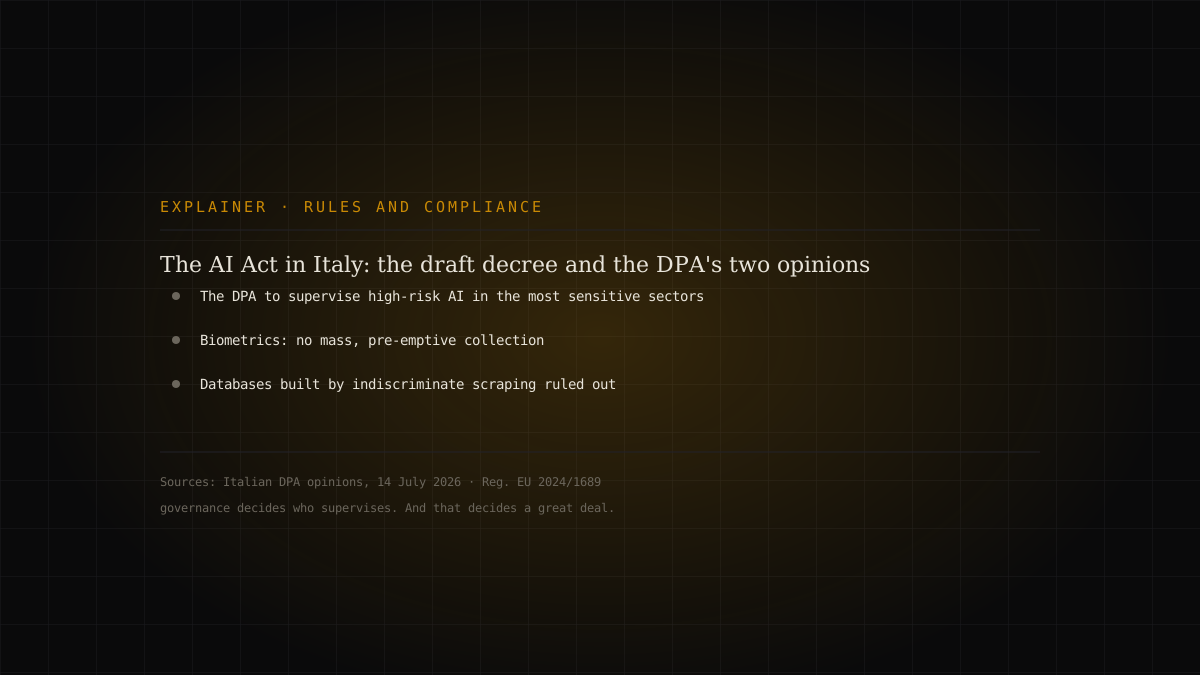
On 14 July 2026 the Italian Data Protection Authority issued two opinions on the draft legislative decree implementing Regulation (EU) 2024/1689, the AI Act, in Italy. Both are favourable, which is the least interesting part: what matters are the conditions. The decree designates the DPA as market surveillance authority for high-risk AI in the sectors most sensitive to fundamental rights, and regulates the use of AI by police forces. On biometrics the Authority is blunt: automated, blanket processing of people entering public places or events is not consistent with the AI Act.

The missing piece between the regulation and reality
A European regulation applies directly: it does not need transposing. But "applies" and "works" are different things, and the difference is almost always the same one: who supervises, with what powers, with what penalties. That is the layer regulations leave to member states, and the layer where it is decided whether a rule becomes a practice or a paperwork exercise.
For the AI Act — Regulation (EU) 2024/1689 — that piece is arriving in Italy now, as a draft legislative decree implementing delegation law no. 132/2025. On 14 July 2026 the Italian Data Protection Authority issued two opinions on the draft, made public in the newsletter of 29 July. Both favourable. And that is the least meaningful part: opinions of this kind are read for the conditions, not the verdict.
What the decree does
The draft sets up the national system of governance and supervision for artificial intelligence. The most consequential passage for anyone working with data: it designates the DPA as market surveillance authority for high-risk AI systems used in the sectors most sensitive to fundamental rights.
- 01Justice and law enforcementthe DPA as market surveillance authority
- 02Immigration and border managementsame scope
- 03Democratic processessame scope
Alongside this, the decree introduces rules for the financial and insurance sectors and promotes digital literacy and training on the informed use of AI in schools, universities and professional pathways. A second title of the draft — the subject of the companion opinion — governs the use of AI by police forces, setting limits, conditions and safeguards for biometric data processing and remote biometric identification.
The DPA's conditions, one by one
The green light comes with a list of requests worth reading in full, because it describes in the negative where the draft is currently vague.
Soft law powers. The DPA asks to be granted the power to adopt guidelines, recommendations and good practices on a par with the other authorities competent for AI. That is less technical than it sounds: in a new field, the first instrument needed is not a fine, it is advance guidance on how to do things.
Clarity on penalties. The Authority asks that the rules for applying the penalties within its remit be clarified, in line with the Italian Privacy Code. The issue is the overlap between two sanctioning regimes bearing on the same conduct.
Role in conformity assessment. The DPA asks that its role be clarified in conformity assessment procedures for high-risk systems, for which the AI Act assigns it specific supervisory functions.
Regulatory sandbox. It asks to be involved in the Italian AI regulatory sandbox and, more generally, in any regulatory experimentation involving personal data processing.
Automated decisions at work. This is the proposal with the widest impact on companies: extending the ban on decisions based solely on automated systems to assessments that significantly affect the employment relationship — performance, bonuses, career progression.
Resources. Finally, the DPA flags the need to align its financial resources with its new competences. Put that way it reads like a footnote; in practice it is the variable that decides whether supervision exists or is nominal.
Biometrics: the sharpest part
On the second draft — the one on police forces — the Authority is more direct, and on one point leaves no room.
The reasoning is linear. The AI Act permits facial recognition ex post only for targeted searches: it follows that biometric processing should occur only on recordings already acquired and where a specific operational need exists, avoiding mass, pre-emptive collection. Automated, generalised processing of the biometric data of people entering public places or events, the DPA writes, is not consistent with the regulation.
Then comes the request that closes the loop with a recurring theme: that the provisions on biometric identification introduced by the new article 359-ter of the code of criminal procedure include an express ban on using databases obtained through indiscriminate scraping or in breach of data protection law. This is where AI governance and data protection stop being two parallel conversations: a recognition system can be technically impeccable and still be unlawful because of how it was trained.
On the rest of the second draft, the DPA asks for clarity on the role of human oversight, for more precise definition of responsibilities in research and testing projects, and for stronger safeguards on the quality of the biometric databases used for identification.
What changes for an organisation, and what does not
A necessary caveat: these are opinions on a draft, not a text in force. The decree may change, and the DPA's conditions may be accepted in full, in part, or not at all. Reading these lines as a list of enforceable obligations is getting ahead of the process.
That said, two signals are already legible. First: if you operate in the listed sectors — or supply systems to those who do — your counterpart for high-risk AI in Italy will be the data protection authority. Not a brand-new regulator to learn from scratch: an authority with settled practice, its own case law and a known way of reasoning about purpose, proportionality and retention.
The second concerns everyone, and it is the proposal on automated decisions at work. If accepted, the scope would move from "hiring and firing" to performance reviews, bonuses and progression: tools many companies already run, often bought as a feature of an HR suite and never classified as AI systems. It is worth knowing now which ones they are and what they decide on their own.