Attribution NOT confirmed. Ransom-ISAC refers to «alleged Cl0p»; ReliaQuest states the actor «remains unconfirmed»critical
A few dozen servers, holding the blueprints for everything: extortion on PTC Windchill
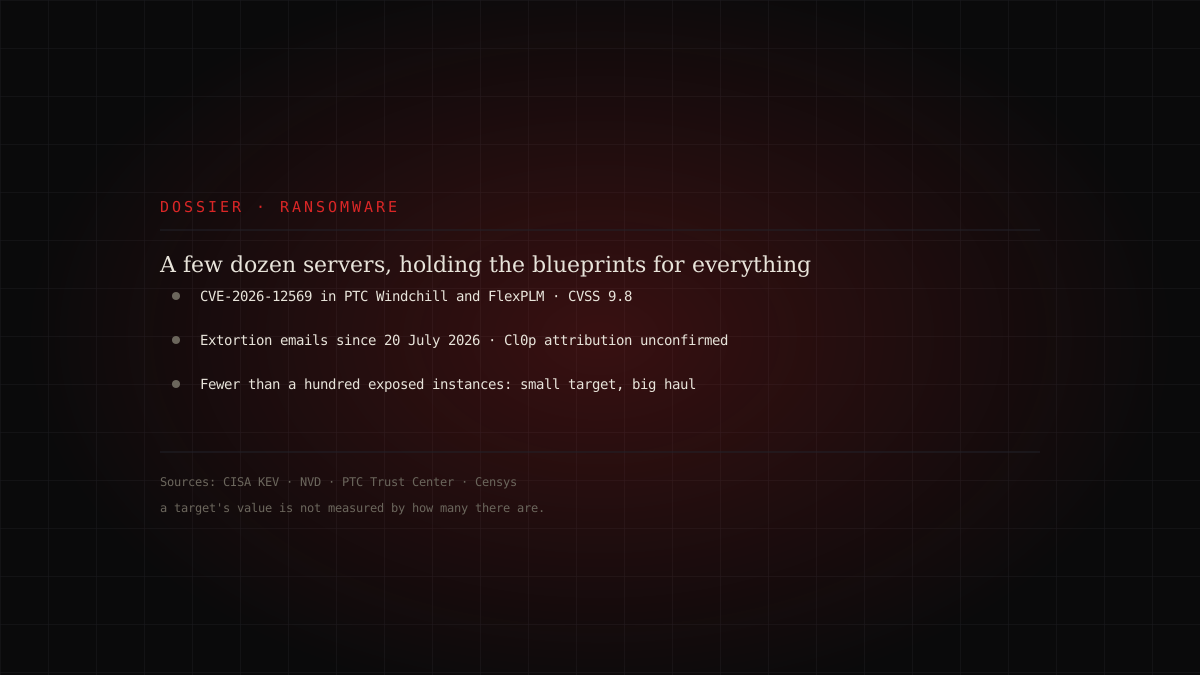
CVE-2026-12569 is an unauthenticated remote code execution vulnerability in PTC Windchill and FlexPLM: the systems where manufacturers keep the drawings, bills of materials and revision history of their products. CVSS 3.1 of 9.8 per NIST, 9.3 in CVSS 4.0 per PTC. In CISA KEV since 25 June, marked «knownRansomwareCampaignUse: Known». From 20 July 2026 Ransom-ISAC observed a wave of mass extortion emails aimed at affected organisations. Attribution to Cl0p is suspected and unconfirmed, and that needs saying. The number of exposed instances is small — fewer than a hundred according to Censys — and that is precisely the interesting part of the story.

What lives inside a PLM system
PLM stands for Product Lifecycle Management. Without the acronym: it is the archive where a company that makes physical things keeps everything about its products. Three-dimensional models, technical drawings, bills of materials — the exact list of components and suppliers — tolerances, material specifications, the history of every revision and the reason it was made.
FlexPLM is PTC's variant for fashion and retail: the same logic, applied to sample ranges, collections and specification sheets.
It is worth pausing on what losing that content means. It is not a customer list, which can be rebuilt. It is the industrial design: the how, not just the what. For many manufacturers that archive is the company, in the sense that it is the part you cannot recreate in six months.
The vulnerability
On 17 June 2026 the NVD record for CVE-2026-12569 was published, described as «A critical remote code execution (RCE) vulnerability... may be exploited through the deserialization of untrusted data». Affected versions are those prior to release 11.0 M030 and «all CPS versions».
CISA describes it in complementary terms: «PTC Windchill and FlexPLM contains an improper input validation vulnerability allowing an unauthenticated, remote attacker to execute arbitrary code by sending a malicious request to the network». The catalogue entry carries two classifications, CWE-20 and CWE-502.
There are two scores and both should be cited, because they are computed with different versions of the standard: CVSS 3.1 of 9.8 assigned by NIST, vector AV:N/AC:L/PR:N/UI:N/S:U/C:H/I:H/A:H, and CVSS 4.0 of 9.3 assigned by PTC as CNA. This is not a contradiction: CVSS 4.0 weighs some factors differently. Both say critical.
On 25 June the CVE entered the CISA KEV catalogue with a remediation deadline of 28 June: three days. And with a marking that deserves attention, because it differs from nearly all the ones we have discussed recently: knownRansomwareCampaignUse: "Known". CISA does not write «Unknown»: it states that use in ransomware or extortion campaigns is known.
- 17 June 2026The CVE
Published on NVD: unauthenticated RCE, CVSS 9.8.
- 25 June 2026Into CISA KEV
Marked «knownRansomwareCampaignUse: Known», deadline 28 June.
- 14 July 2026Full patches
PTC releases the definitive fixes.
- 20 July 2026The extortion wave
Ransom-ISAC observes mass extortion emails going out.
- 27 July 2026Updated IOCs
PTC updates the indicators in its active advisory.
How it surfaced
On 20 July 2026 the visible phase began. Ransom-ISAC describes it this way: «On 20 July, Ransom-ISAC began observing an alleged Cl0p ransomware... data extortion campaign sending emails with a subject line, "Windchill PDMLink module serious data leak"... sent to hundreds of users within an impacted organization».
The detail not to miss is in that last line: the emails do not go to legal counsel or the head of security. They go to hundreds of people inside the affected organisation. It is a pressure technique we have seen elsewhere, and there is nothing technical about it: it turns a problem the leadership might handle quietly into a problem everyone knows about.
Technically, the coordinated advisory published on 22 July by Ransom-ISAC together with eCrime.ch and DEFUSED describes a two-stage chain: a pre-authentication information disclosure on the FlexPLM WSDL endpoint, combined with a flaw in the Windchill login servlet. Among the indicators: JSP webshells with hexadecimal names under /Windchill/login/, matching the pattern [0-9a-f]{16}.jsp; a flst.txt file used to enumerate the filesystem; the command-and-control header X-windchill-req: ?x8Fmgow.
It should be stated clearly that no data encryption is documented. This is theft-based extortion: the content is taken and money is demanded for not publishing it. The word «ransomware» describes the suspected group and the business model, not what happened to the machines.
The number that inverts the intuition
The analysis Censys published on 30 July contains the most counterintuitive figure in the story: internet-exposed instances number «fewer than 100» since 1 June. 80% in the United States; roughly a quarter of the hosts on Akamai infrastructure.
For comparison, again per Censys: the 2023 MOVEit campaign involved «over 2,000 instances», the 2025 Oracle E-Business Suite one «over 2,700 instances».
Fewer than a hundred. Censys's comment is the sentence to take away: «an exposure does not have to be widespread or globally prominent to be a valuable target».
This should change how the severity of an advisory is read. The useful question is not «how many exposed systems are there», but «what is inside an exposed system». A hundred industrial design archives belonging to automotive and aerospace firms are worth more, to an extortionist, than two thousand generic file transfer servers. It is also why niche technology is not sheltered: a small, specialised target is easier to enumerate, not harder.
What to do
Update: the full patches date from 14 July. Anyone who applied only the late-June mitigations should confirm they have moved to the definitive fixes.
Hunt for indicators, do not stop at the version number. The CVE has been in KEV since 25 June and the exploitation window opened earlier: updating today says nothing about what happened in the preceding weeks. JSP files with hexadecimal names under /Windchill/login/, the presence of flst.txt and the X-windchill-req header in web server logs are the starting point. PTC's active advisory, updated on 27 July, is the source to consult for the current list.
Take Windchill off the internet. A design archive has no reason to be publicly reachable. Where external access is needed — suppliers, plants, design studios — it should be mediated, not published.
Prepare internal communications before you need them. In this campaign the extortion note reaches hundreds of employees at once. If staff are the first to know anything and nobody knows what to say, reputational damage outruns the technical investigation.
What we do not know, and it needs saying
Attribution is not confirmed. Ransom-ISAC writes «alleged Cl0p»; ReliaQuest is more explicit still: «The actor behind these attacks remains unconfirmed. However, the observed tradecraft shares characteristics with previous Cl0p campaigns». Similarity of tradecraft is not identification.
Zero-day use is a supposition, not a fact. The hypothesis that the flaw was exploited before disclosure is stated by Ransom-ISAC with «We suspect».
There are no victim or ransom figures. As of 22 July no victims had been published on the leak site and the campaign had not been formally claimed.
No MITRE ATT&CK IDs have been published for this campaign in any of the sources consulted. We are not deducing them: an invented mapping is worse than an absent one.
A note on method, finally: PTC is the affected vendor, and Ransom-ISAC, eCrime.ch, DEFUSED, ReliaQuest and Censys are private sources. The two independent public sources underpinning the established part of this dossier — the existence, severity and real-world exploitation of the vulnerability — are NVD and the CISA KEV catalogue.