Editorial explainer · official sourcesmedium
Who notices: Italy's numbers on minors online, and where the reports come from
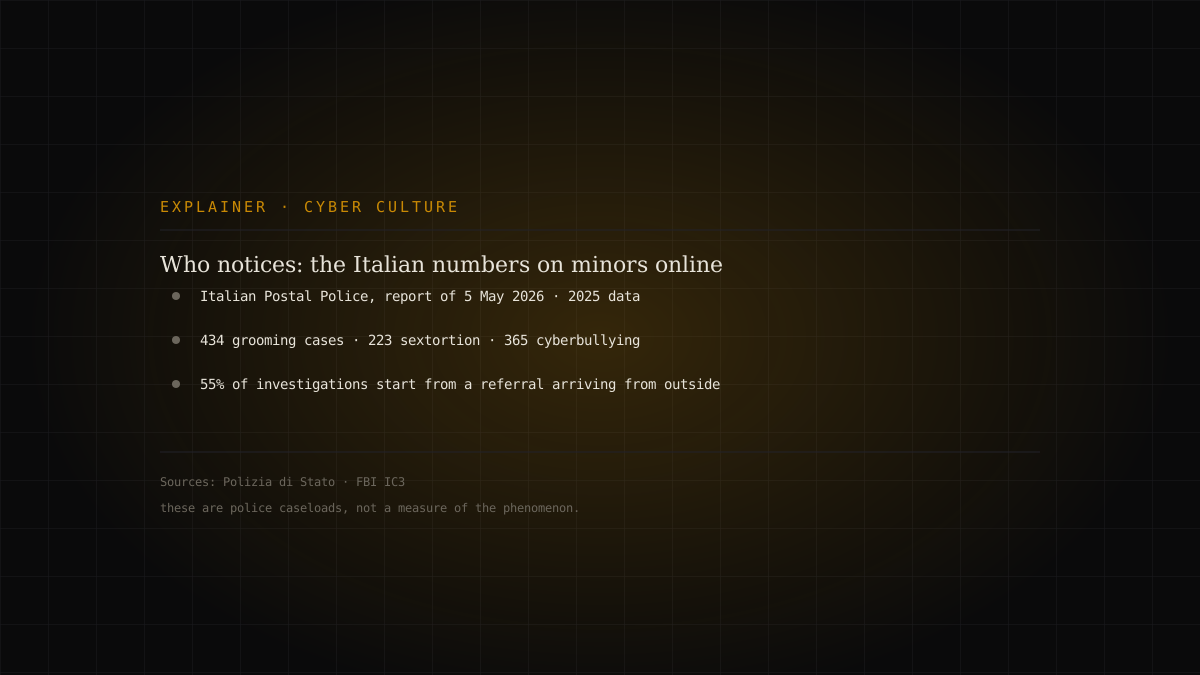
On 5 May 2026 the Italian Postal Police published its annual report on online offences against minors, with 2025 data consolidated as at 31 December. The figures: 434 grooming cases handled, 223 sextortion cases, 365 cyberbullying cases. But the number that says most about the protection infrastructure is a different one: of 2,623 child sexual abuse material cases handled, 1,441 proceedings — 55% — arose from reports arriving from outside, chiefly from the US centre that collects platform notifications. The same report flags the expiry, on 3 April 2026, of the European regulation that allowed platforms to carry out voluntary detection, and the resulting «regulatory gap».

What these numbers actually count
Before the data, a caveat that changes how to read it. The figures in «Tracce digitali, vittime reali», published on 5 May 2026, are cases handled by the Italian Postal Police: they are not a count of victims, not a count of offences committed, not an estimate of how widespread the phenomenon is. They measure how much reached the attention of investigators.
The distinction applies to all police statistics and weighs more than usual here, because the interesting part of this report is precisely how cases arrive.
To these should be added 29 cases of unlawful image sharing with minor victims. On countering child sexual abuse material, 2025 closed with 2,623 cases handled, 224 arrests, 1,085 people reported while at liberty, 1,039 searches and 1,309 individuals identified; 16,609 sites were analysed, of which 2,876 were placed on a block list.
A note on the figures: the Postal Police statement of 10 January 2026 reported 2,574 proceedings and 222 arrests, with data «consolidated as at 21 December»; the May report gives 2,623 cases and 224 arrests with data consolidated as at 31 December 2025. The difference is the ten-day tail, not a revision.
The number that explains how protection works
Of 2,623 cases handled, the report states that «as many as 1,441 proceedings arose directly from reports channelled» by the US centre that collects notifications sent by platforms.
55% of the national centre's investigative caseload therefore originates outside Italy and outside the police: it originates in a detection made by a platform, passed to a body that routes it to the competent national authorities.
- 01The platformdetects content or behaviour within its own services
- 02The referralgoes to the centre that collects notifications and routes them by country
- 03The investigationreaches the Italian national centre: in 2025, 55% of proceedings started this way
This has a direct consequence, and it is why the report highlights it. Regulation (EU) 2021/1232 — the rule that allowed communications service providers to carry out voluntary detection of this material by derogation from confidentiality rules — expired on 3 April 2026. The report states that «the resulting regulatory gap significantly weakens the instruments of prevention and enforcement».
In practical terms: more than half of Italian investigations in this field depend on an activity that, after April 2026, no longer has the same legal basis. This is not a forecast, it is the reading given by those who receive the referrals.
Where the risk concentrates, by age
The age breakdown shows a consistent picture across the three phenomena. Grooming concentrates in the 10-16 age band, with 179 cases aged 10-13 and 238 aged 14-16: the band in which a child gets a personal device and begins using platforms where you talk to strangers — game chats, social networks, messaging services.
Sexual extortion is shifted much further along: 193 of 223 cases involve the 14-17 band, 86% of the total. That makes sense: the dynamic presupposes that something has already been shared, so it arrives later.
Cyberbullying follows the same curve, with 265 of 365 cases in the 14-17 band.
International comparison confirms this is not specific to Italy. The US annual report on internet crime for 2025 records over 75,000 reports of sexual extortion and over 5,700 reports involving minors forwarded to the body that collects them. Among complainants aged 17 or under, 13,168 reports were filed for $12,988,892 in stated losses, and the largest category is extortion, with 5,151 reports.
What changed in Italian law
One element of the report deserves to be known because it is recent and little publicised: Law no. 132 of 23 September 2025 introduced Article 612-quater into the criminal code, «Unlawful dissemination of content generated or altered by artificial intelligence systems», punishable by one to five years' imprisonment.
It is the legislative answer to a dynamic that bears directly on minors: the ability to generate false but plausible images from ordinary photographs, and to use them as blackmail material. Until then the conduct fitted awkwardly inside rules designed for real content.
What an adult can concretely do
The lever of blackmail is shame, and it is defused in advance. The useful moment is not when something happens: it is the earlier conversation establishing that if something goes wrong online, the reaction at home will not be punitive. A young person who fears their parent's reaction more than the blackmailer does not ask for help — and the blackmailer knows it and counts on it.
If blackmail is already under way: do not pay, do not delete, ask for help. Paying does not close the demand, it confirms it. Deleting the account removes the evidence and not the copy the other side holds. Conversations and profiles should be preserved and handed to investigators: reports can be made at a local Postal Police station or through the Italian police's dedicated portal.
Reporting to the platform is not a symbolic gesture. 55% of investigations start exactly there. The report button inside the app is, statistically, the channel that brings more cases to investigators' attention than any other route.
Reducing exposure matters more than surveillance. Profile privacy settings, restrictions on who can send direct messages and turning off profile visibility to strangers act on the entry point — the initial contact — rather than on the young person's behaviour, which is the hardest thing to police and the easiest to move to another app.
On the institutional side, the report notes 18 operational cyber security centres and 82 operational sections across the country, and a prevention programme that in 2025 reached 4,309 schools, 324,702 students, 25,838 teachers and 17,085 parents.
What we do not know
The data covers cases handled by the specialist service, not real prevalence: a rise in cases may indicate growth in the phenomenon or growth in the capacity to detect it, and these numbers cannot tell the two apart. The report gives no breakdown by platform. The US figures cited are self-reported, cover the United States only and are not transferable to Italy: the document itself warns that age is not a required field for complainants, that each report is assigned a single offence category and that duplicate reports may exist.
If this article touches on something close to you, the subject is a sensitive one: speaking to a trusted person or a specialist is a reasonable step, and we can point to the relevant resources on request.