Unattributed (first observed on Defused honeypots; no public campaign or actor)critical
The module that moves the payments, taken without a login: CVE-2026-46817 in Oracle E-Business Suite
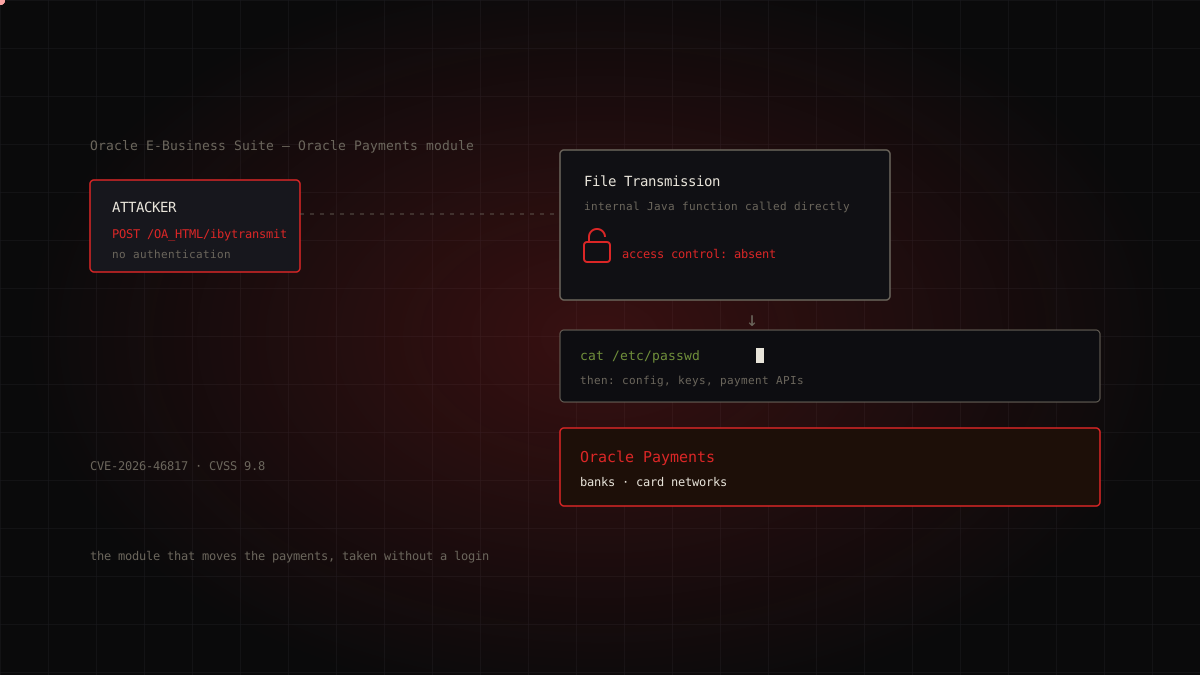
Oracle Payments is the payment engine inside Oracle E-Business Suite: the point where the company's finance applications talk to banks and card networks. CVE-2026-46817 (CVSS 9.8) lets an unauthenticated attacker with only HTTP access compromise and take over the module. The exploit hits the ibytransmit endpoint of the File Transmission component, which invokes an internal Java function directly: patched in late May, the flaw was exploited in the wild from 27 June — before any public PoC — and added to the CISA KEV catalog on 15 July.

The place where the money leaves
Inside Oracle E-Business Suite — the constellation of applications that runs the finance function of a great many large organizations — Oracle Payments is the module that does one thing: move payments in and out. It centralizes how the accounting applications talk to banks and card networks, and to do that it handles banking-system credentials, encryption keys, payment-processor APIs. It is not a peripheral service: it is the point where the company touches the money.
On 15 July 2026 CISA added CVE-2026-46817 to its catalog of known exploited vulnerabilities. It is a CVSS 9.8 flaw in Oracle Payments that lets an unauthenticated attacker, with only HTTP access to the console, compromise and take over the module. No login, no token, no account: the request arrives and is served.
- Late May 2026Patch
Oracle fixes the flaw in its May Critical Patch Update.
- 27 June 2026First exploitation
Defused honeypots record the first in-the-wild execution, before any public PoC.
- 15 July 2026
exploitationCISA adds CVE-2026-46817 to the KEV catalog.
- 18 July 2026Deadline
CISA's remediation due date for federal agencies.
"Unauthenticated" is not a picked lock
The detail that makes this flaw worse than average isn't the score — CVSS 9.8s come by the dozen — but where the check is missing. According to Defused's analysis of the observed activity, the exploit hits the ibytransmit endpoint of Oracle Payments' File Transmission component and calls an internal Oracle Java function directly, redirecting it to read a file from the server. In the recorded episode, the file was /etc/passwd: the classic arbitrary-read proof, harmless in itself, that shows the mechanism works.
The point is that this internal function was never meant to be reachable from outside. The endpoint calls it without anyone, anywhere along the path, checking who is asking. Oracle's own description isn't of a single bug but of three weaknesses living together: improper privilege management, improper authentication, and missing authentication for a critical function. "Unauthenticated," here, doesn't describe a picked lock: it describes a lock that was never fitted to that door.
- 01HTTP requestPOST to /OA_HTML/ibytransmit, no credentials
- 02Internal Java functionthe endpoint invokes it directly, no access control
- 03File read from the server
/etc/passwdin the proof; then config, keys, payment APIs - 04Module compromisefrom arbitrary read to takeover of Oracle Payments
From reading one file to the wallet
In the observed episode the attacker read /etc/passwd — that is, almost nothing. But the same technique, Defused warns, reaches far more sensitive files: configuration files holding database credentials, encryption keys, payment-processor APIs. This is where the distance between "reading a trivial system file" and "controlling the module that moves the payments" shortens fast — and why Oracle describes the maximum impact as takeover of the module, with confidentiality, integrity and availability compromised together.
It is worth stating precisely what was seen and what wasn't. What Defused recorded is a single source running an unauthenticated file read against the Payments component: a targeted proof-of-concept, not broad scanning. Full takeover is the maximum impact Oracle declares on the basis of the vulnerability, not an end-to-end chain observed and documented in real traffic. The difference matters: we know someone opened the door, we don't have a public report showing what was done inside.
Not the first time — and that's the point
If this story sounds familiar, it is. In autumn 2025 another critical flaw in the same product — CVE-2025-61882, also CVSS 9.8 — was exploited by actors tied to the Cl0p ransomware operation for theft and extortion, with attacks starting as early as August; CVE-2025-61884 followed shortly after. In early July 2026 Oracle patched a missing-authentication zero-day in PeopleSoft (CVE-2026-35273) exploited in data-theft attacks attributed to ShinyHunters. Oracle's internet-facing enterprise suites have become a recurring initial-access surface.
That is the most useful lesson here, more than the single CVE: when a product collects critical unauthenticated flaws in under a year, the question stops being "did I apply the latest patch?" and becomes "does this component really need to be on the internet?" A payments module that talks to banks and card networks has no reason to offer its console to the world.
What we don't know — and should say
Some things stay open, and it's right to write them down. There is no attribution: no named actor, no public campaign, and the KEV catalog lists ransomware-campaign use as "Unknown." The only evidence of exploitation is Defused's observation on its own decoy — a single source, however specific.
The score is Oracle's CNA figure (9.8): NVD has received the record but hasn't yet published its own assessment or CWE enumeration. The technical mechanism beyond the file read — which Java function, what path leads from file-read to takeover — is not publicly detailed, and this dossier does not go into operational specifics you don't need in order to defend yourself. Finally, the ATT&CK IDs at the top — T1190 and T1552.001 — do not come from an Oracle or CISA advisory: they are a reasoned mapping of what the flaw enables (reach an exposed application and read credentials from files), not a value copied from a primary source.
What to do, now
The fix has been out since late May: applying Oracle's May 2026 Critical Patch Update closes the flaw on versions 12.2.3–12.2.15. Until the maintenance window, the highest-impact mitigation is the simplest — EBS web interfaces should not be reachable from the internet, but restricted to the internal network.
For retrospective hunting, the indicator is concrete: unexpected POST requests to /OA_HTML/ibytransmit in web-tier logs. Anyone finding evidence of compromise should treat the instance as breached, run a full forensic review, and rotate every credential and key stored on that host — because that is exactly what the file read was able to reach. The patch is nearly two months old: the window between "available" and "exploited" closed in six weeks, and whoever watched only the patch calendar, not their own exposure, kept that window open.