Qilincritical
Qilin and the Interest on Technical Debt: Logging Into a VPN Without a Password
A logic flaw in certificate validation during the IKEv1 key exchange let attackers open an authenticated Check Point VPN session without knowing any password. Qilin had been using it for a month before the vendor noticed. But the bug isn't the story — the story is that it only bites organisations that never switched off a dead protocol.

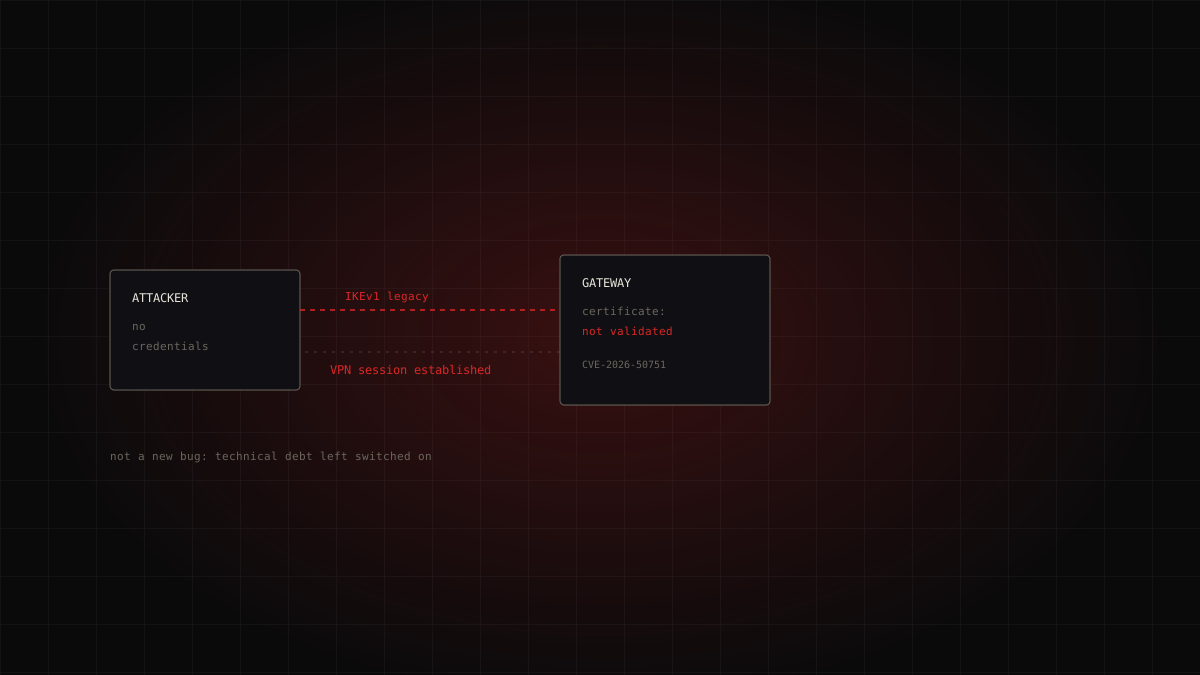
On 7 May 2026, someone opened a VPN session on a Check Point gateway without knowing a password. They didn't guess it, didn't buy it from a broker, didn't pull it out of a credential dump. They simply didn't need one.
Check Point spotted it on 4 June — roughly a month later. On 8 June the company shipped a hotfix and published advisory sk185033. The same day, CISA added CVE-2026-50751 to its Known Exploited Vulnerabilities catalog and gave federal civilian agencies until 11 June to remediate. Three days: the floor allowed under BOD 22-01. CISA does not hand out three-day deadlines for theoretical risk.
- 7 May 2026The passwordless session
someone opens a VPN session on a Check Point gateway.
- 4 June 2026The discovery
Check Point spots it, roughly a month later.
- 8 June 2026The hotfix
the patch ships, alongside advisory
sk185033. - 8 June 2026The KEV listing
CISA adds
CVE-2026-50751to the Known Exploited Vulnerabilities catalog. - 11 June 2026The deadline
three days for federal civilian agencies, the floor under BOD 22-01.
The origin
The flaw is classified CWE-287, Improper Authentication. It isn't a buffer overflow and it isn't an injection — it's a reasoning error. During the IKEv1 key exchange, the gateway validates certificates incompletely, and that gap yields an authenticated VPN session with no credentials at all. There's no payload to craft, no race to win. There's a door that opens.
Third-party sources put the score at CVSS 9.3. That figure deserves an asterisk: it was assigned by third parties, and at time of publication NVD had not yet issued an official score. The number is circulating, but it isn't canonical yet.
One condition narrows the whole thing. The flaw only reaches gateways that expose legacy IKEv1 and don't enforce a machine certificate. Force IKEv2 and you're not affected. Require Machine Certificate Authentication and you're not affected. IKEv1 has been deprecated for years — obsolete RFCs, retirement guidance, a replacement available for over a decade.
So this isn't a new bug. It's technical debt calling in the loan. A 2026 CVE exists because in 2016, in 2019, in 2023, nobody turned off a protocol everyone agreed should be turned off. The vulnerability was discovered this year; the decision that made it exploitable is years old, and it was made — or avoided — by an administrator who had a "legacy client compatibility" checkbox and chose to leave it ticked.
The attack chain
- 01IKEv1the gateway validates certificates incompletely: a VPN session with no credentials
- 02Toxpeer-to-peer encrypted command and control, with no central server to seize
- 03Rcloneexfiltration to cloud storage, with traffic that looks like a backup job
- 04Rented VPSnodes chosen close to the target, so no impossible-travel rule trips
- 05Encryptionphase not publicly confirmed for this incident
After initial access (T1190, Exploit Public-Facing Application; T1133, External Remote Services), the operators — tracked by Trend Micro as Water Galura — move with real discipline. Command and control runs over Tox: peer-to-peer, encrypted, with no central server to seize. Exfiltration runs through Rclone to cloud storage (T1567.002) — a legitimate, signed tool whose traffic looks like a backup job.
The infrastructure is rented VPS: Kaupo Cloud Hong Kong, Shock Hosting, Vultr. The telling detail is the geographic correlation between victim and infrastructure. Nodes are chosen close to the target, because a VPN session from an IP in the same region trips no impossible-travel rule. That's an evasion decision, not a latency one.
This is where the reconstruction stops, and it's worth being precise about where. The encryption phase is not publicly confirmed for this incident. What is documented is initial access and exfiltration. Whether this was a double-extortion attack carried through to impact, a campaign stopped short, or a pure data-collection operation with no intent to encrypt, public sources don't say.
The same caveat applies to the TTPs generally associated with Qilin — T1003.001 (LSASS dumping), T1486 (Data Encrypted for Impact), T1490 (Inhibit System Recovery), T1036.005 (Masquerading). Those come from other cases. They are useful as a forecast, not as reporting: no source confirms them here. Treating them as established fact would mean inventing a forensic report that doesn't exist.
Victimology is opaque too. Check Point refers to "a few dozen global organisations." No sector, no country and no names have been made public.
Detection
For once the advantage is that the signal is structural rather than behavioural.
- Inventory gateways with IKEv1 enabled. This is a configuration, not an inference — you read it, you don't deduce it. IKEv1 on plus machine certificate not enforced puts a system inside the blast radius.
- Hunt for authenticated VPN sessions with no matching authentication event. That's the most direct fingerprint: a session that exists although nobody ever presented credentials.
- Correlate source IP geolocation against your actual footprint. Geographic proximity is engineered to look normal — but a commercial VPS IP in a region where you employ nobody is still an anomaly, however "nearby" it is.
- Watch outbound Rclone traffic: large volumes to cloud storage from segments that don't back up to the cloud.
- Look for Tox traffic, which has no legitimate reason to exist on a corporate network.
Remediation
Order matters here, because step two makes step one nearly redundant.
- Apply hotfix sk185033. Immediately. Non-negotiable.
- Disable IKEv1 and force IKEv2. This is the actual fix: it kills the whole class of problem, not one CVE.
- Drop legacy client support. It's the reason IKEv1 was on in the first place; while it stays, the box gets re-ticked.
- Enforce Machine Certificate Authentication.
- Turn IPS on at the gateway.
- Require MFA on all VPN access.
Check Point further reports that the same infrastructure is likely hitting Palo Alto, Fortinet and F5 as well. If that holds, this isn't a campaign against one vendor — it's a campaign against the edge-appliance category, and patching only Check Point means closing one window in a room with four.
What it teaches
One line in MITRE ATT&CK matters more than the CVE itself. Qilin is catalogued as S1242, and the page notes that Moonstone Sleet — a North Korean state group — has deployed Qilin.
That's where the "ransomware equals financial crime" category quietly breaks. A state actor doesn't license ransomware to get rich; it uses ransomware because it's ready-made infrastructure, deniable, and indistinguishable from criminal background noise. The RaaS economy has stopped being a market and become a shared platform for crooks and governments alike. Which means attribution, when you're staring at a Qilin encryptor, tells you almost nothing about motive — and the threat model that starts "we're too small to interest a nation-state" has just lost its premise.
The operational lesson is duller, and more uncomfortable. This attack didn't succeed on the strength of a brilliant exploit. It succeeded because a protocol that should have been dead years ago was still answering. The gap between "deprecated" and "disabled" is where ransomware crews live — and no hotfix closes it. It gets closed by someone willing to break a legacy client, take the support calls the next morning, and switch IKEv1 off.